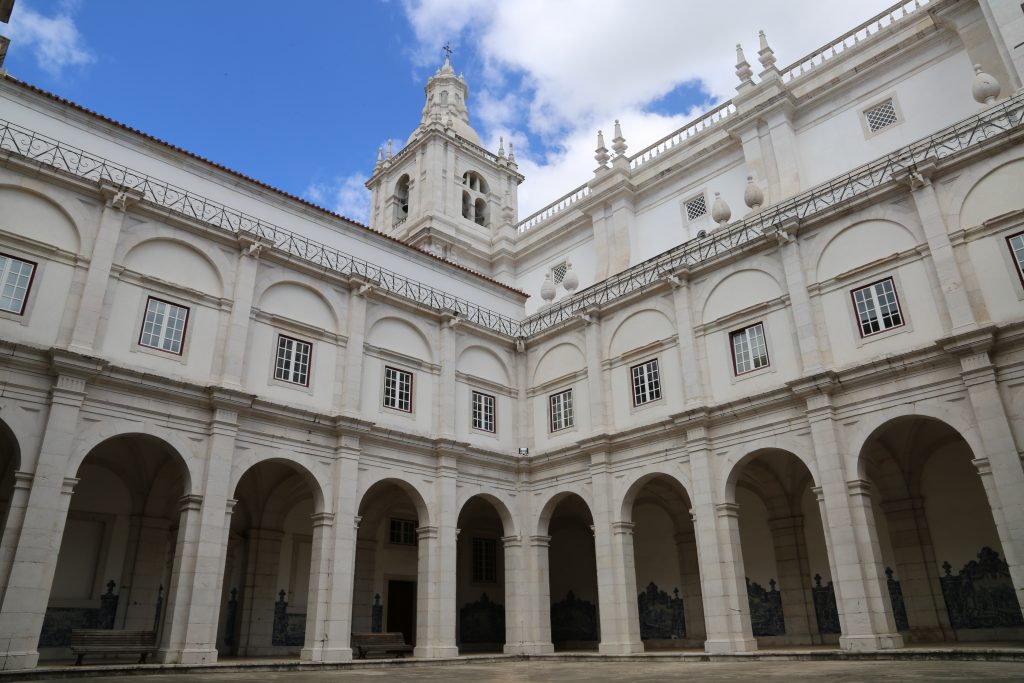
Cloisters
The two cloisters give access to important dependencies around it such as: the church, the chapter room, the library, the sacristy, the refectory, among others. These spaces were intended for contemplation, reflection, prayer, and also served as a “spiritual passage”, where the canons regular would prepare themselves before initiating the divine office.
Architecturally very sober, the cloisters were erected during the 2nd half of the 17th century, following an initial project designed by Juan Herrera (1530-1597), which was commissioned by D. Felipe I of Portugal (II of Spain).
In 1737, the walls were fully coated with 65 glazed tiles panels, which are credited to Valentim de Almeida’s workshop. Similar to the other glazed tiles panels produced during this period, commonly known as the ‘Great Joanine Production’ (1725-1750), these also feature exuberant and monumental frames.
The scenes depicted are profane and were inspired by engravings that portrayed the daily life of the French aristocracy, such as: hunting, fishing, landscapes, dancing, playing traditional games, among other examples. The Monastery of São Vicente de Fora is one of the monuments in the world, with the most baroque glazed tiles in their original place. The collections include over 100,000 glazed tiles (approximately 222 panels).